
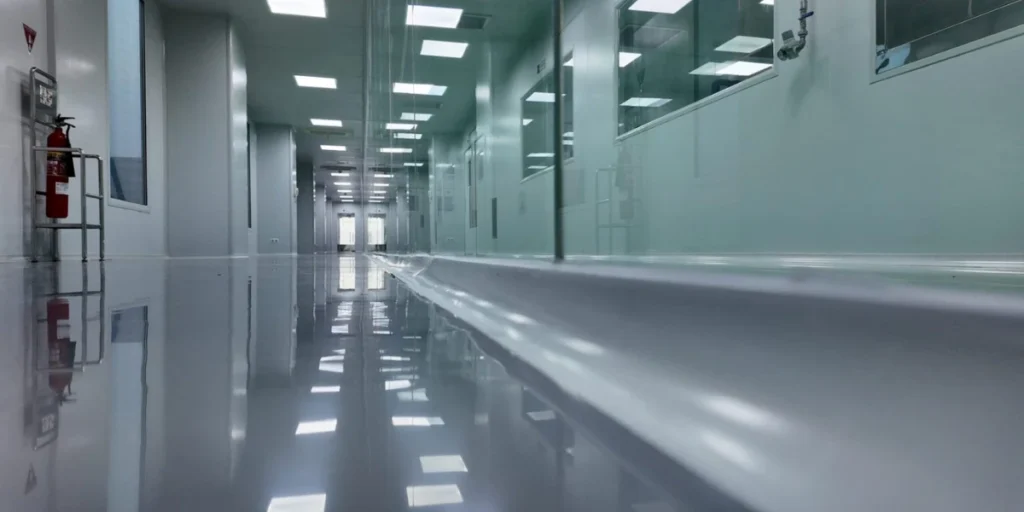
Service Name:
Cleanroom Epoxy Flooring Systems
1. What Is Floor Epoxy?
Epoxy flooring is a protective coating made from epoxy resin that is applied to floor or wall surfaces to provide mechanical strength, chemical resistance, and enhanced cleanliness. In pharmaceutical facilities, epoxy is widely used because it is easy to clean, antibacterial, and resistant to cleaning chemicals and disinfectants.
2. Functions of Epoxy in Pharmaceutical Facilities
Cleanliness & Hygiene: Smooth, non-porous surface prevents microorganism growth
Chemical Resistance:: Resistant to solvents, disinfectants, and cleaning agents
Safety & Sterility: Seamless surface reduces contamination risks
Mechanical Strength: Withstands heavy loads, friction, and production equipment traffic
Aesthetics & Safety: Available in various colors and can include safety lines or zoning markings
3. Key Components of Epoxy
Epoxy Resin: Main material providing chemical resistance and strong adhesion
Hardener (Curing Agent): Chemical component that hardens the resin through reaction
Pigmen & Additive: Provide color and additional properties such as anti-slip or anti-static features
4. Epoxy Design & Specifications
Thickness: 1 mm – 5 mm depending on requirements (coating, self-leveling, or mortar system)
Finish Type: Glossy, matte, anti-slip, or anti-static (ESD)
Application Systems: :
Epoxy Coating: Thin layer, cost-effective, suitable for light-duty areas
Epoxy Self-Leveling: 2–3 mm thickness, smooth and seamless surface
Epoxy Mortar: 3–5 mm thickness, designed for heavy-duty areas with high load
5. Epoxy Installation Process
Surface Preparation
Grinding or shot blasting to clean and remove old coatings
Repair of cracks and surface leveling of concrete
Cleaning of dust, oil, and contaminants before application
Primer Application
First layer applied to improve adhesion between concrete and epoxy system
Main Layer Application
Epoxy resin and hardener mixture applied using roller or trowel
For self-leveling systems, material is evenly spread to achieve a seamless surface
Top Coat / Finishing
Final protective layer for durability and aesthetic appearance
Can be customized as anti-slip or anti-static depending on requirements
Services Provided:
DESIGN
We create facilities that are safe, efficient, and compliant with regulations before entering the construction and operational stages.
EXECUTION
We transform designs into fully operational facilities with guaranteed quality, safety, and regulatory compliance.
BPOM ASSISTANCE
We support you in ensuring a smooth BPOM inspection process and obtaining the necessary certifications required for operation.